
Resources
Welcome to our Resources Center! Here you'll find free calculators, checklists, guides, and educational tools designed to help real estate investors evaluate opportunities, reduce risk, and make informed funding decisions.
Investing Tips
Know Your Numbers Before You Make an Offer
Always calculate your purchase price, estimated rehab cost, ARV, and projected profit before submitting an offer. Use our Deal Analyzer on the homepage to run the numbers quickly.
Get Multiple Contractor Bids
Never rely on a single contractor estimate. Get at least three bids for any rehab project to ensure your cost projections are accurate and competitive.
Understand Your Local Market
Study comparable sales (comps) in the neighborhood before purchasing. ARV is only as accurate as the comps you use to support it.
Budget for the Unexpected
Add a 10–15% contingency buffer to your rehab budget. Unexpected costs are common in renovation projects — plan for them upfront.
Focus on the Exit Strategy First
Before you buy, know exactly how you plan to exit — sell, refinance, or rent. Your exit strategy determines which loan product is right for your deal.
Work With Experienced Professionals
Surround yourself with a reliable team: a knowledgeable real estate agent, a trusted contractor, a title company, and a private money lender who understands investor needs.
Glossary of Terms
After Repair Value (ARV)
The estimated market value of a property after all planned renovations and repairs have been completed. Lenders use ARV to determine the maximum loan amount for fix-and-flip projects.
Asset-Based Lending
A lending approach where the loan is secured primarily by the value of the collateral property rather than the borrower's credit score or income. Evolutionary Private Funding uses asset-based underwriting.
Consideration
Part of the Purchase and Sales Agreement representing the purchase price, earnest money deposit, and any other obligations, such as repairs or services, promised by either party.
Contingency
A condition or stipulation in a contract that must be satisfied for the agreement to be binding. If the contingency is not met, the contract may be canceled without any penalty.
DSCR (Debt Service Coverage Ratio)
A measure of a property's ability to cover its debt obligations using its rental income. A DSCR above 1.0 means the property generates enough income to cover the loan payments.
Equity
The difference between the current market value of a property and the outstanding balance of all loans secured against it. Equity represents the owner's financial stake in the property.
HUD Statement
Also known as the HUD-1 Settlement Statement, is a document provided to the buyer and seller at the closing of a real estate transaction in the United States. It itemizes all the charges and credits associated with the closing, including loan fees, escrow terms, and other costs.
LTC (Loan-to-Cost) vs LTV (Loan-to-Value)
LTC and LTV both evaluate real estate risk, but they measure debt against different baselines. LTC divides the loan amount by the total cost to build or renovate. LTV divides the loan by the property's expected market value upon completion. Both are represented as a percentage.
Points
Upfront fees charged by a lender at closing, expressed as a percentage of the loan amount. One point equals 1% of the loan. Points are common in private money lending.
Private Money Brokers
Intermediaries who bring together and oversee the application and loan packaging process between Private Money Institutions and Real estate investors/borrowers seeking short-term funding for non-owner occupied real estate transactions.
Private Money Loan
Also referred to as a Hard Money Loan, is an asset-backed loan used primarily by real estate investors to buy or renovate property. Instead of focusing on your credit score, lenders base approval on the property's value and your investment strategy.
Private Money Lender
An individual or company that provides real estate loans funded by private capital rather than bank deposits or government programs. Private money lenders typically offer faster closings and more flexible terms.
Rehab Cost
The estimated total cost of all repairs, renovations, and improvements needed to bring a property to its target condition. Accurate rehab estimates are critical to evaluating deal profitability.
Title Insurance
A one-time insurance policy that protects property owners and lenders against financial loss resulting from defects in a property's title, such as undisclosed liens, ownership disputes, fraud, or errors in public records.
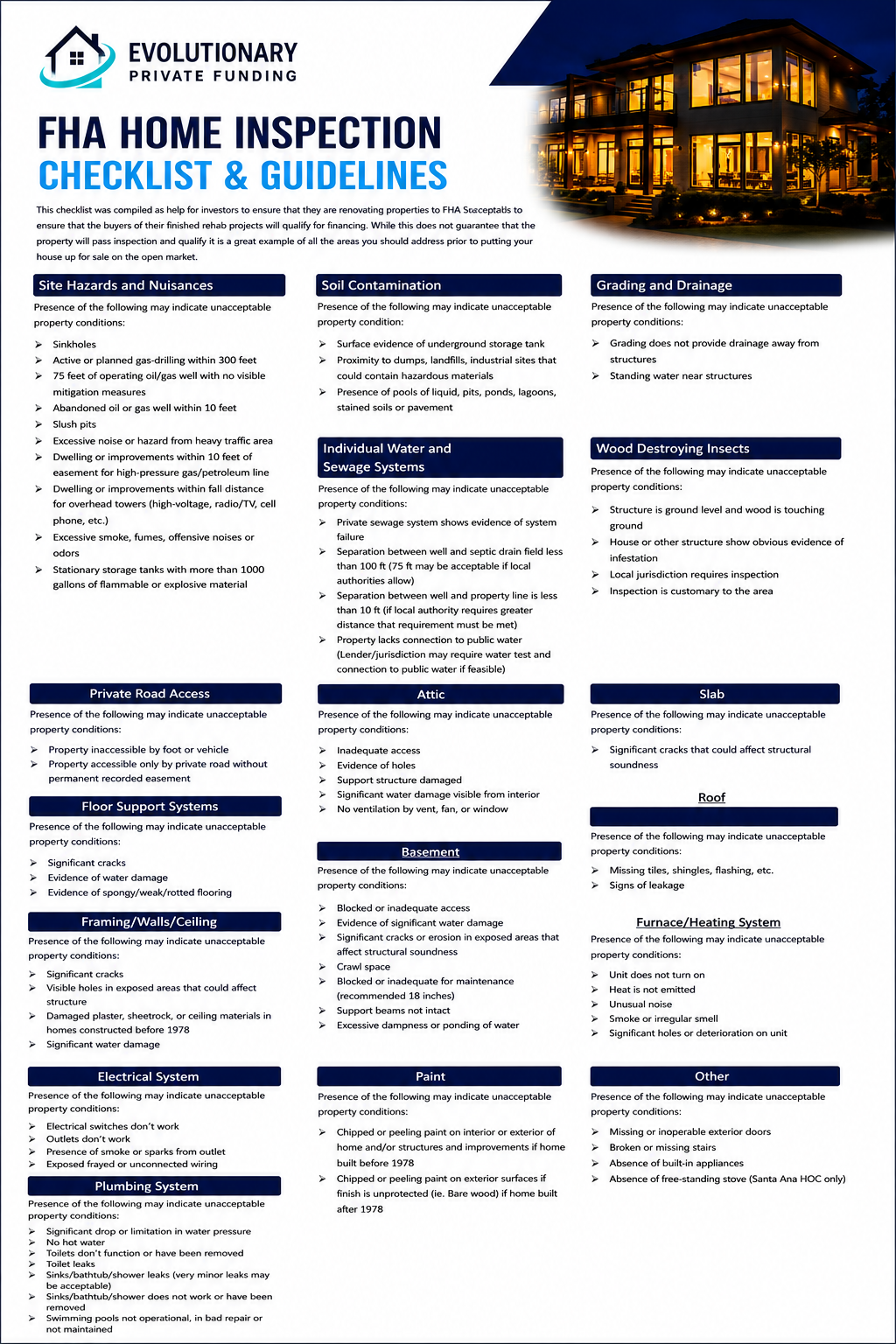
FHA Inspection Guidelines
This checklist was compiled as a guide for investors renovating properties to FHA-acceptable standards, helping ensure that buyers of finished rehab projects can qualify for financing. Use it as a reference before listing your property on the open market.
Purchase & Sale Agreement
This document is provided as a SAMPLE for your PRIVATE use only. As with any SAMPLE document, you should consult an attorney as to its applicability for any particular purpose and for compliance with the laws of the state in which you reside. You acknowledge that no legal advice has been provided to you nor is any legal advice being provided to you by way of this SAMPLE document being provided to you. Evolutionary Private Funding LLC or The Irish Phoenix, CCorp make no claims or warranties as to the SAMPLE document's fitness for any particular purpose whatsoever. By using this SAMPLE document, you are specifically assuming all liability for its use and agreeing to fully indemnifying Evolutionary Private Funding LLC or The Irish Phoenix, CCorp from any liabilities, suits, claims, demands, causes of actions, damages, losses, costs and expenses result from your use of this SAMPLE document.
Download Purchase & Sale AgreementWhen the bank says NO, click Laurimo!
Non-owner occupied properties only. No application fees. Fast closings.
Contact Us Today